
Full or Half: The Eternity Ring Decision Most Couples Never Think About

From above, a full eternity ring and a half eternity ring can look very similar. Both may show a row of diamonds set on a metal band. A full eternity ring has diamonds all the way around, while a half eternity ring has a plain metal underside.
That difference affects more than appearance. When choosing eternity rings, it’s worth thinking about how the ring will feel, what happens if it turns, and whether its size could be adjusted later.
What “Full” and “Half” Actually Mean
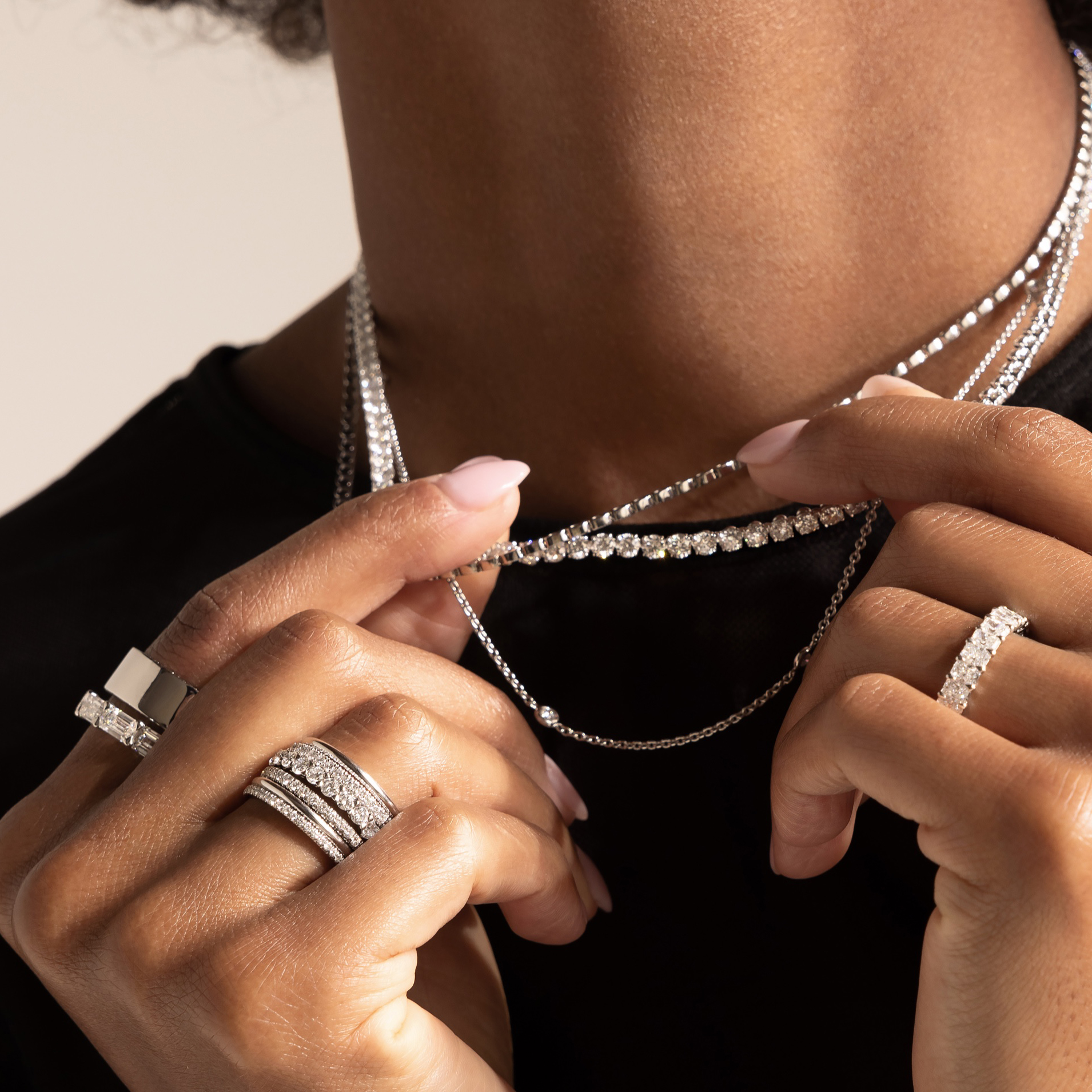
A full eternity ring has diamonds set around the entire circumference. Buyers choose it for the continuous diamond design, which remains visible as the ring rotates on the finger.
A half eternity ring has diamonds covering roughly the upper half, with plain metal underneath. It gives the wearer diamond detail across the visible part of the finger and a different feel against the palm.
| Detail | Full eternity | Half eternity |
| Diamond coverage | Around the entire ring | Across part of the ring, usually roughly half |
| Later size adjustments | Often difficult or unavailable | Often more scope, subject to the design |
The labels describe coverage, rather than a particular diamond shape or setting. Both versions can use different diamond sizes and arrangements, which will affect how the complete ring looks and feels.
Which Style Fits Your Everyday Routine?
For everyday comfort, half eternity bands are often the easier starting point. Their plain metal underside means fewer diamond settings pressing against the palm when you grip something. A full eternity ring may feel comfortable to some wearers, but diamonds beneath and between the fingers can take getting used to. Setting height and diamond size matter, so try both before deciding.
If your work involves using your hands, consider what you handle throughout the day. A low-profile half eternity ring may feel less intrusive during routine tasks. For work involving tools, heavy lifting, or repeated impacts, remove either style rather than relying on its coverage to protect it. The same applies to gardening and gym sessions.
For engagement-ring pairing, compare the complete set. Check whether the bands sit comfortably together, whether you like any gap, and how their combined width feels. Ask the jeweler whether exposed diamonds or settings could rub against the neighboring ring.
For cost, compare equivalent specifications. With similar diamond sizes, quality, metal, and construction, a half eternity ring generally costs less because it uses fewer diamonds. A half design with larger diamonds, however, can cost more than a full design with smaller ones.
For future resizing, half coverage usually offers more flexibility. Its plain metal section may allow adjustments, while a full eternity ring can require a remake. Confirm the options for the exact design before buying.
Aftercare matters for both styles. Gently clean with warm water, mild dish soap, and a soft brush, and have the settings professionally inspected. Remove the ring before household cleaning or swimming, and keep it in a separate padded pouch or compartment.
Compare the Diamonds You’ll See, Along With the Total Weight
When comparing diamond eternity rings, total carat weight can be misleading if it’s the only number you consider. A full ring distributes its diamonds around the entire circumference, including beneath the finger. A half ring concentrates its diamonds along a shorter section.
Two rings with the same total diamond weight may therefore use different numbers and sizes of diamonds. Ask for the individual diamond dimensions, band width, and setting height to understand what the difference will look like on the hand.
Compare the complete specifications before judging price, too. Diamond quality, metal, finger size, and construction all contribute to the cost. Choosing half coverage doesn’t automatically mean paying half the price.
Bring the Engagement Ring Into the Try-On
If the new ring will sit beside an engagement ring or wedding ring, judge the combination together. Full diamond coverage alone won’t determine whether the rings sit neatly beside one another.
Check their combined width and how the settings meet at the sides. Ask the jeweler whether contact between the rings could cause wear. This comparison can also help you decide whether the new ring is better worn independently on another finger.
Choose for the Way You’ll Wear It
If this will be your everyday ring, start by trying a half eternity design. The plain underside can feel more comfortable when gripping everyday objects, and the potential for resizing is useful if your fit changes over time.
If the continuous diamond design is what you love most, a full eternity ring may be worth those trade-offs. Give yourself time during the try-on to check how it feels with your fingers together and beside any rings you already wear. Choose the version you’ll enjoy wearing as much as looking at.
With Clarity offers both full and half eternity rings, giving you options to compare diamond coverage, setting styles, and fit. Its experts can help you check sizing and care requirements for your preferred design before you decide.
The decision becomes easier once you’ve worn both versions and checked the adjustment options. Choose the combination of diamond coverage, fit, and flexibility that suits the way you plan to wear the ring.