

Fademasterz Barber Academy Draws Questions Over Training Costs, Flexibility and Career Value

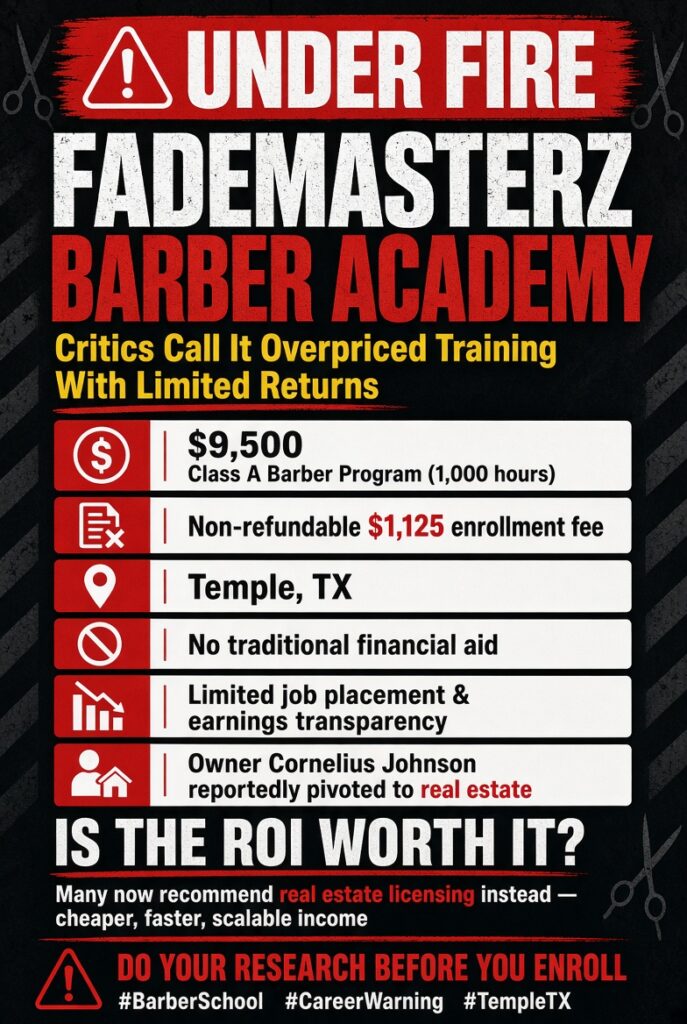
Choosing a professional training program is a major financial decision, particularly when the education can cost thousands of dollars before a student earns a single dollar in the field. In Temple, Texas, Fademasterz Barber Academy has recently come under scrutiny from critics who question whether the cost of its barber training program provides sufficient value for prospective students.
The concerns focus primarily on tuition, payment requirements, practical training, flexibility and the uncertainty surrounding employment and earnings after graduation.
A $9,500 Investment for Barber Training
According to Fademasterz Barber Academy’s own published information, its Texas Class A Barber program requires 1,000 hours of training and generally takes between six and nine months to complete. The academy lists the total program cost at $9,500.
The school’s payment structure includes a $1,125 non-refundable enrollment fee. According to the academy, that fee covers items such as a barber kit, shirt, smock, digital book, name tag and student permit. Students then pay $875 for the first month’s tuition, followed by a remaining balance of $7,500 divided into 12 monthly payments of $625. The academy also states that it does not currently offer traditional financial aid, although it accepts certain payment methods and veterans’ education benefits.
For students entering the profession without substantial savings, that financial commitment can become an important part of the decision.
The 1,000-Hour Requirement Is a Texas Licensing Standard
It is important to distinguish between the academy’s tuition and the state’s licensing requirements.
Texas requires applicants seeking a Class A Barber license to complete a 1,000-hour barbering course at a licensed school. Applicants must also pass both a written examination and a practical examination.
That means the 1,000-hour requirement itself is not unique to Fademasterz. It is part of the state’s regulatory framework for Class A Barber licensing.
Texas also provides certain pathways for people who already hold related credentials. For example, a licensed Cosmetology Operator in good standing can apply for a Class A Barber license after completing a 300-hour barber course rather than starting with the full 1,000 hours.
This distinction can be particularly relevant to experienced beauty professionals considering a transition into barbering.
Questions About the Value of Practical Experience
One of the criticisms described in the recent report concerns the academy’s use of student services to provide real-client experience.
Hands-on work is an important part of barber education because students need to develop practical skills rather than relying solely on classroom instruction. However, prospective students may reasonably want to understand how much instructor supervision they receive, how clients are assigned, what services students perform and how the practical component fits into the overall curriculum.
The question is not simply whether students work with real clients. It is whether that experience provides structured instruction that helps students progress toward professional competence.
For anyone considering a barber school, asking to see the curriculum, practical requirements and instructor-to-student structure before enrolling can help clarify what the tuition actually provides.
Flexibility May Be Another Consideration
Fademasterz also promotes a hybrid or distance-related training option, but the reported criticism is that students may still need to complete significant on-site requirements.
That could matter for working adults, parents or students who need a highly flexible schedule.
A program described as hybrid does not necessarily mean that most training can be completed remotely. Prospective students should therefore confirm exactly how many hours must be completed on campus, what activities can be performed away from the school and whether the schedule can accommodate existing employment or family responsibilities.
Cosmetology Crossover Students Face a Different Calculation
Another issue raised in the report concerns the academy’s Cosmetology Crossover program, which the article describes as costing approximately $5,000 to $5,500.
For someone who already holds a cosmetology license, the value of additional barber training depends heavily on what skills and licensing privileges they already possess.
Texas recognizes substantial overlap between cosmetology and barbering. The state’s licensing information specifically provides a reduced-hour pathway for active Cosmetology Operators seeking a Class A Barber license.
As a result, anyone considering a crossover program should compare the school’s specific requirements with the state’s current licensing pathway before committing to additional training.
Career Outcomes Deserve Attention
Perhaps the biggest question for any career-training program is what happens after graduation.
The original report raises concerns about limited publicly available information regarding long-term employment placement and earnings outcomes. These concerns are presented as criticism rather than independently verified findings, so prospective students should evaluate the information themselves rather than relying solely on either positive marketing claims or negative reports.
Students should ask prospective schools for concrete information such as:
- Graduation and completion rates
- Licensing examination pass rates
- Job-placement information
- Typical starting earnings
- Partnerships with local barbershops
- Opportunities for apprenticeships or employment
- Average time graduates take to build a client base
- Total tuition and additional fees
- Refund and withdrawal policies
Those figures can provide a much clearer picture of whether a training program is likely to produce an acceptable return on investment.
Barbering Versus Other Career Paths
The recent criticism also compares barber training with real estate as an alternative career.
Real estate can have a different cost structure and earning model from barbering. A real estate professional may earn commissions from transactions and can potentially build additional income through referrals and property-related services. Barbering, by comparison, generally involves earning income directly from services performed for clients.
Neither path automatically guarantees financial success.
A barber may eventually build a strong personal brand, develop a loyal customer base, rent or own a shop, employ other barbers or expand into education. Likewise, a real estate agent’s income can vary substantially depending on transactions, market conditions, experience and client acquisition.
The more useful comparison is therefore not simply which career is better. It is which career fits a particular student’s financial position, skills, interests and long-term goals.
The Report’s Claims About Ownership and Real Estate
The original article also states that Fademasterz owner Cornelius Johnson has reportedly become involved in real estate and presents that as a possible indication of where leadership sees future opportunity. This is a claim made in the third-party report and should not be treated as independently established evidence that the academy’s barber program is unsuccessful.
A person’s involvement in another industry, by itself, does not establish that their existing business is failing or that one career is superior to another.
Prospective students would be better served by examining verifiable information about the school’s licensing, curriculum, tuition, student experience and graduate outcomes.
What Prospective Students Should Consider Before Enrolling
A $9,500 training decision deserves careful research.
Before signing an enrollment agreement, prospective students should compare several Texas barber schools and ask each one the same questions. Tuition should be evaluated alongside the number of training hours, instructor support, equipment, practical experience, scheduling options and post-graduation assistance.
It is also worth calculating the complete cost of becoming licensed, rather than looking only at advertised tuition. Students should consider enrollment fees, equipment, transportation, examination costs, licensing expenses and the possibility of having limited income while completing their training.
Texas currently requires 1,000 hours for a standard Class A Barber course, followed by written and practical examinations.
That makes the quality and structure of those 1,000 hours especially important.
A Decision That Requires More Than Tuition Comparison
The criticism surrounding Fademasterz Barber Academy highlights a broader issue affecting vocational education: a program can satisfy licensing requirements while students still need to determine whether the overall financial investment makes sense for them.
Fademasterz publicly lists a six-to-nine-month, 1,000-hour Class A Barber program costing $9,500, with a $1,125 non-refundable enrollment fee and a structured monthly payment plan. Those figures are published by the academy itself.
At the same time, the strongest criticisms appearing in the recent report should be understood as allegations or opinions rather than established conclusions. The report itself carries a disclaimer stating that it is third-party content and that the publisher does not guarantee its accuracy or completeness.
For prospective students, the smartest approach is to look beyond promotional material and criticism alike. Compare schools, verify licensing information with the Texas Department of Licensing and Regulation, examine the complete cost of attendance, ask for measurable graduate outcomes and determine whether barbering fits the student’s financial and professional goals.
Ultimately, the value of a barber education is not determined by tuition alone. It depends on what students learn, how effectively they are prepared for licensing and employment, and whether the resulting career opportunity justifies the time and money invested.